Introduction
This essay seeks to explore how the shifting depictions of the utopic/dystopic city has manifested in seminal science fiction films of the last century and how this can be read alongside recent utopic critique as an indictment of the failures of postmodern architectural praxis to offer architectural development which moves beyond and against cynical complicity with late-stage capitalism and the shift towards the post-industrial epoch. The essay explores the way architecture as a discipline is itself sheltered against utopic dreaming by the insecure yet supposedly infallible guise of irony and spectacle.
Through highlighting the deliberate cognitive estrangement induced in Fritz Lang's Metropolis (1927) and Ridley Scott's Blade Runner (1982) and through a study of the analogous depictions of the utopic/dystopic architecture of the city within these forms of uchronic dreaming, this essay will attempt to tie back the prevalent culture of consumerism which has come to dominate and define architecture under the complete thrall of late-stage capitalism, whilst exploring how this intrinsic connection between mass culture consumerism and architecture necessitates the role of both 'the architect' and 'the architecture' as commodities which create a repudiation and contempt for anything more progressive than status quo reproduction of the schizophrenic and pastiche aesthetic language of mesmerising architectural style.
The art of cinema, as a somewhat recent human cultural phenomenon, is perhaps one of the more powerful indicators of zeitgeist. As a representational medium, cinema holds a prized position at the centre of cultural production due to its near universal accessibility by audiences through its undeniable embrace of modernity. It may not be surprising then that film relies often upon the bombastic language of what Guy De Debord calls 'The Spectacle' in capturing the attention of the masses.
Walter Benjamin's, (the founder of Marxist hermeneutics alongside Fredric Jameson) seminal work in cultural studies The Work of Art in the Age of mechanical Re-production (1935) frames the role of film and modernity succinctly: By close-up of the nothings around us, by focusing on hidden details of familiar objects, by exploring commonplace milieus under the ingenious guidance of the camera, the film, on the one hand, extends our comprehension of the necessities which rule our lives, on the other hand, it manages to assure us of an immense and unexpected field of action.
It is for this reason that depictions of the possible 'future city' are such a powerful thematic aesthetic attractors in film. Architectural theorist Anthony Vidler argues that cinema not only has an undeniable marked influence on modern architecture, but modern architecture also has a profound influence on cinema whether through décor, mise en scène or the ability given to break out of its 'frame'. It is perhaps no surprise then that Vidler elucidates upon this through the words of famed Soviet film director and film theorist Sergei Eisenstein for whom 'Films undoubted ancestor is – architecture'.
Following this train of thought we can see why within cinema it is the city that is often chosen as the metaphor for exploring ideas related to modernity. The image of the city - either real or imagined, provides a ready map for an understanding of the details, languages, cultures, forms of production and power structures that shape what it means to be modern. Yet as with any map, the artifice in its attempt in static depiction and reproduction of reality fails to accurately show the breadth of fluidity and immeasurable factors that comprise life in the metropolis. Despite this, although rarely accurately prescient, depictions of the 'future city' not only reflect current societal anxieties but also have a profound ability to affect technology, culture, and architecture. They allow for an exploration of potential alternatives of what may be possible, free from the constraints of practicality and immediate contemporary concerns.
The Modern City and Fritz Lang's Vision
In October 1924 the famed Austrian expressionist film-maker Fritz Lang finds himself in Manhattan, New York exploring in a very real way the concrete reality of the city. He is fascinated by the emergence of what we now take for granted as the 'modern city'; glimmering glass towers that seemingly ascend to the heavens. An architecture seemingly impossibly removed from that of the European tradition. Simultaneously fascinated and repelled by the excessive accumulation of what surplus-value can produce under Fordian and Taylorism driven capitalism, Lang questions the social cost of such production, reflecting upon the social upheavals currently transforming the young bourgeois nation of Germany.
Within Germany, in stark contrast to the United States at the height of the roaring twenties, society is immensely fractured. Still reeling from the devastating social and economic realities of The Great War, the polarisation of the nation is palpable. The near advent of a socialist revolution in Berlin and the state of Bavaria results in a dismantling of the worker's movement, but the leftist culture ground swell is still strong particularly emboldened by the complete consolidation of Russia by the Bolsheviks. As the National Socialist German Workers' Party quickly ascends in strength, the German state is paralysed between two competing but also potentially actualised utopias. The first, a socialist state born from the class struggle and armed revolution, the later, the remaking of the German economy through the rising tide of the Industrialists as facilitated by the United States extending arm of globalism.
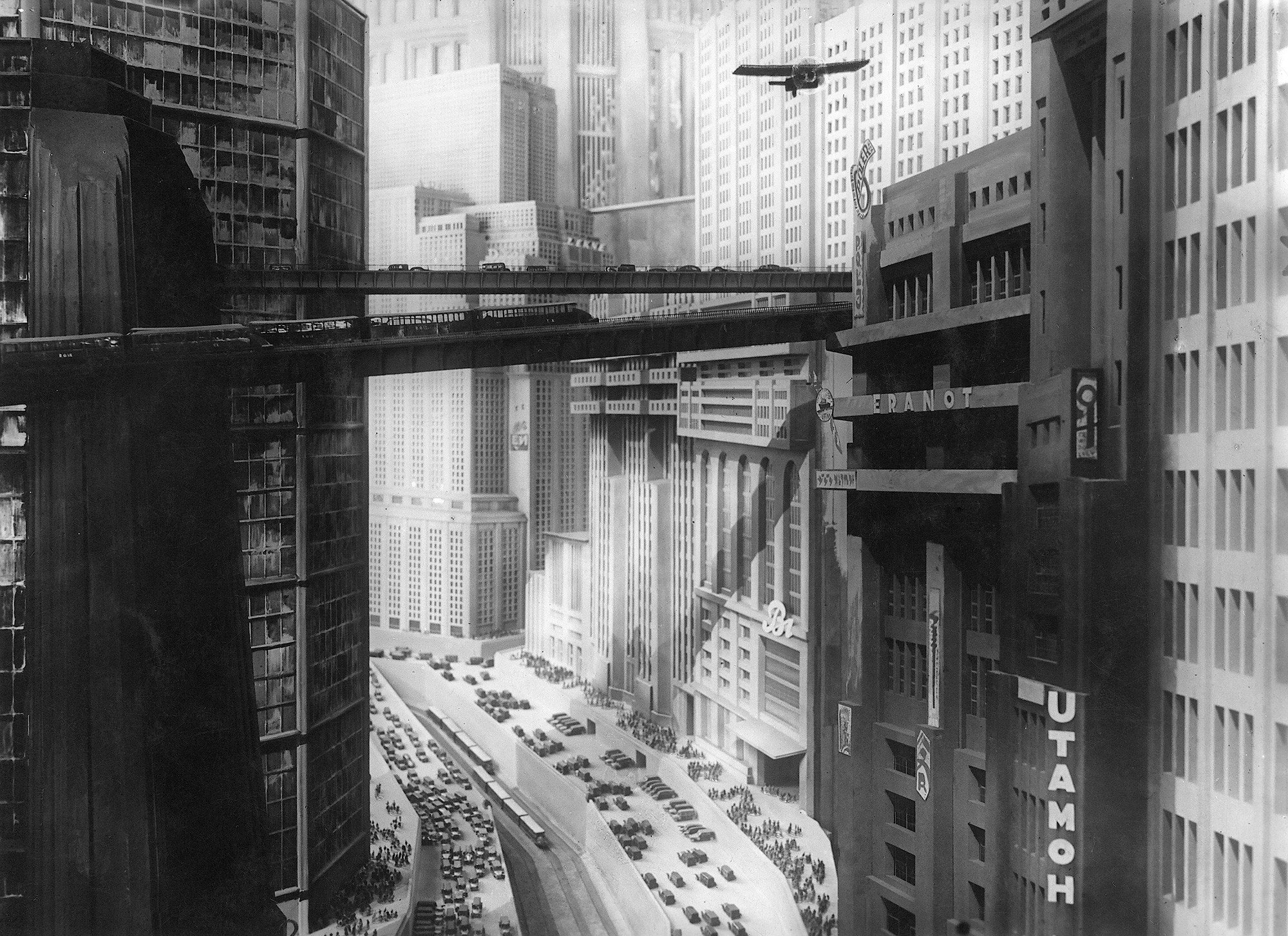
In Fritz Lang's Metropolis (1927) (one of the very first feature science fiction films and predating much of what we consider 'modernist architecture' today.) we are confronted with the uchronia of the futuristic year of 2026, that at first seems a utopic city of the future but quickly turns dystopic. The wealthy ruling class lead lives of hedonism suspended high above the ground in glazed skyscrapers amongst clubs and pleasure gardens whose aesthetic echoes a confusing language of art-deco, techno-city and ancient Athens as envisaged through the modernist language of the architecture. Towering buildings dwarf an urbanity of seemingly swarming automobiles and aircraft impossibly traversing across the verticality of the city.
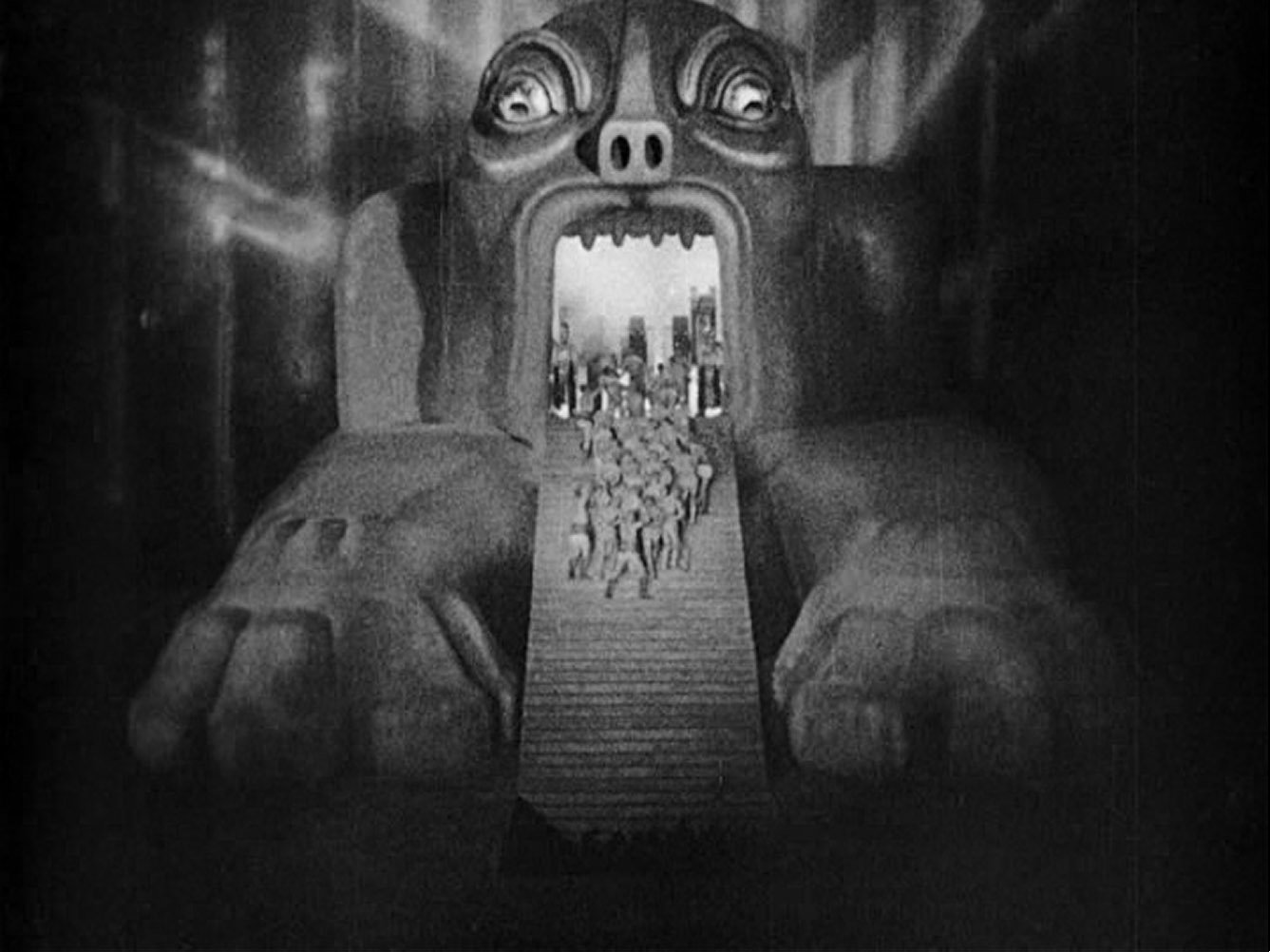
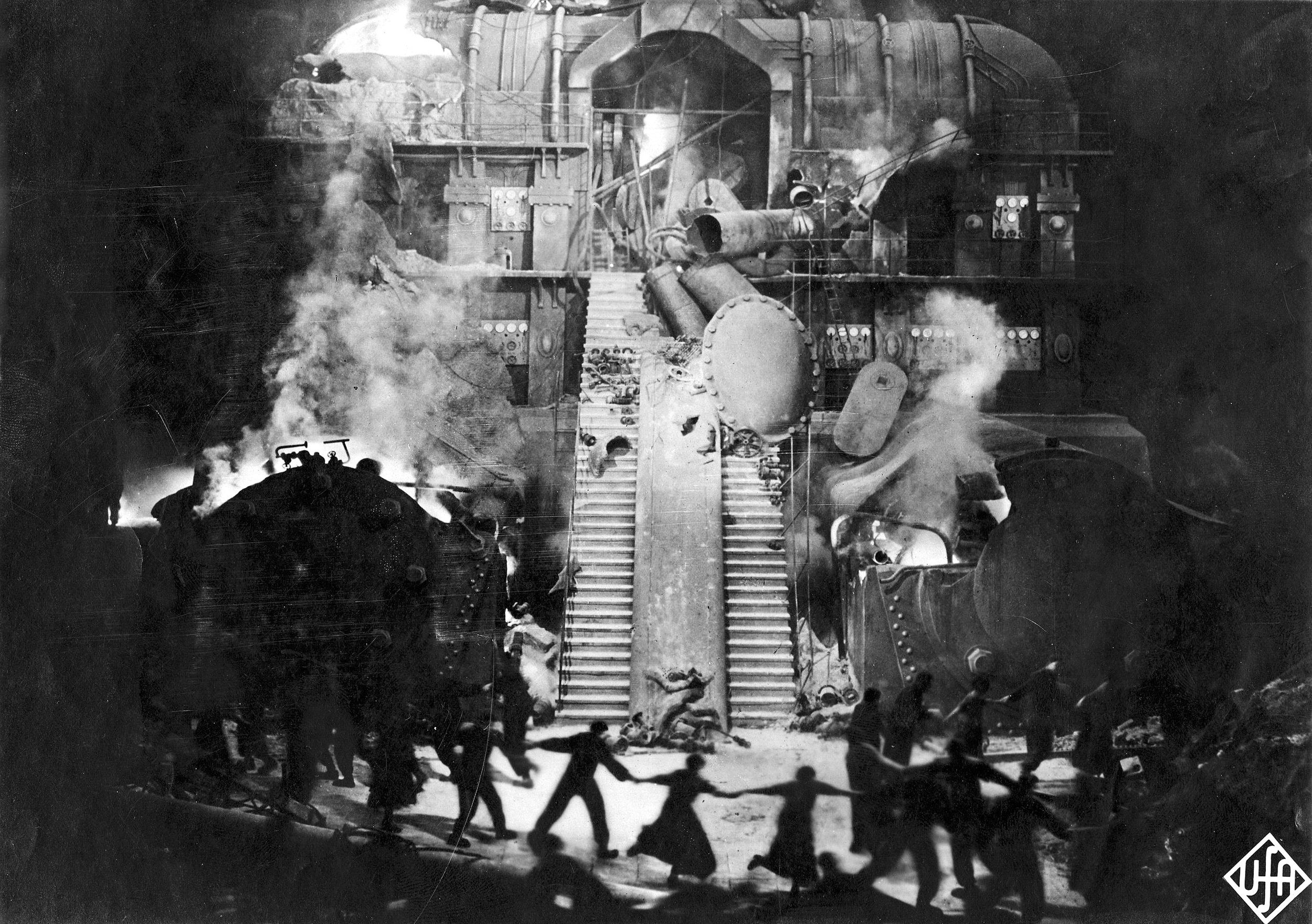
Far below this staggering vertical metropolis lies the workers city, it's inhabitants of which are depicted toiling endlessly in shifts to produce the energy that sustains the city at the cost of their own lives. Depicted through an extended montage sequence that overlays the workers struggle with that of despotic slavery manifest in the biblical image of the Moloch as they feed the 'Heart Machine' of the city. Here Lang explores the frightening dystopia that is true Marx reification, the domination of the embodied work over the living work, of the energy provided to the metropolis over the lives of the workers.
The main plot of the film sees the young son of the ruling-class Master of Metropolis Freder Fredersen fall in love with Maria, the forbidden spiritual leader of the underclass of workers and subsequently attempt to become the prophesised 'mediator' between ruling class or 'the brain' and the working underclass 'the hands'. The plot becomes further complicated with the introduction of the first automata depicted in film (a doppelganger of Maria described as perfect: 'All that is missing is a soul'.) who is utilised by the spurned inventor Rotwang to attempt to deceive the workers into destroying the city and unknowingly their own children in the lower city in the process.
Freder eventually prevails in saving the city as its anointed 'mediator' (read: emergent middle-class), but not before the doppelganger automata is revealed as machine and destroyed by the mob in a luddite-like frenzy which echoes the paranoia of the looming machine-age and the confusion between human and machine. The thinly veiled take away message of the film beyond the somewhat naïve yet earnest character driven 'Between head and hand, heart must mediate' is twofold. First, a warning to the working class against the dangers of rebellion and secondly the triumph of the fictional city belongs not to the workers but rather to the 'mediators'.
Apart from the duality of the potential of the future city and horrors under the surface, the plot of Metropolis is endlessly deep in semiotic and cultural reading not just for the urbanistic problems presented of the machine like 'future city', but for the representation of a class struggle that's only solution is the intervention of the privileged upper class. In playing out the anxieties of a rapidly industrialising urban Germany, the cognitive estrangement fostered so strongly in Metropolis generated a response that would come to shape architectural practice for decades and echoes even today. Depictions of Utopic Urbanism enacts what Le Corbusier amongst other modernists base their attempts at the construction of the 'City of Salvation'.
Blade Runner and the Postmodern City
Much as Metropolis could be seen as attempting to explore and mirror the perceived emergent opportunities and conflicts caused by Fordism and the explosive breakthroughs in technology and modernist urbanity, we can jump forward in cinematic history (and backwards chronologically in fictional timelines) to a vastly different but arguably bleaker vision of the 'future city'. In what could be considered the spiritual successor of Langs Metropolis, we have Ridley Scott's Blade Runner (1982).
Within the 'future city' of Blade Runner we see the devastating effects of the post-industrialist epoch on the city and its inhabitants. Where Metropolis located us in an exaggerated gleaming Manhattan, Blade Runner finds it's backdrop in the decaying fictional 2019 Los Angeles via an injection of Tokyo's electronic aesthetic of neon lights backdropped by ever-present steam, darkness and acidic rain. By way of comparison to the clean and seemingly logical modernist future city found in Metropolis, Los Angeles is pictured as the true postmodern city, steeped in an aesthetic of decay, undergoing the essential self-destruction that post-industrialism unfettered entails.
If the Industrial city as depicted by Metropolis indefatigably never stops producing, in the post-industrial city we find a constant need for recycling, therefor the city requires a never-ending supply of waste. In dystopic 2019, waste is the only way for the squalid urban population to survive, the furnishings of the continuation of the high altar of consumerism manifest in turn, producing an aesthetic of the recycled which permeates the entire film.
In Blade Runner's framing of the 'future city' as being anchored in post-industrial decay, we see the link between postmodernism and late capitalism connected back to Frederic Jameson's formation of Postmodernism as the dominant cultural logic of late capitalism: It is in the realm of architecture ... that modifications in aesthetic productions are most dramatically visible, and that their theoretical problems have been most centrally raised and articulated; it was indeed from architectural debates that my own conception of postmodernism began to emerge.
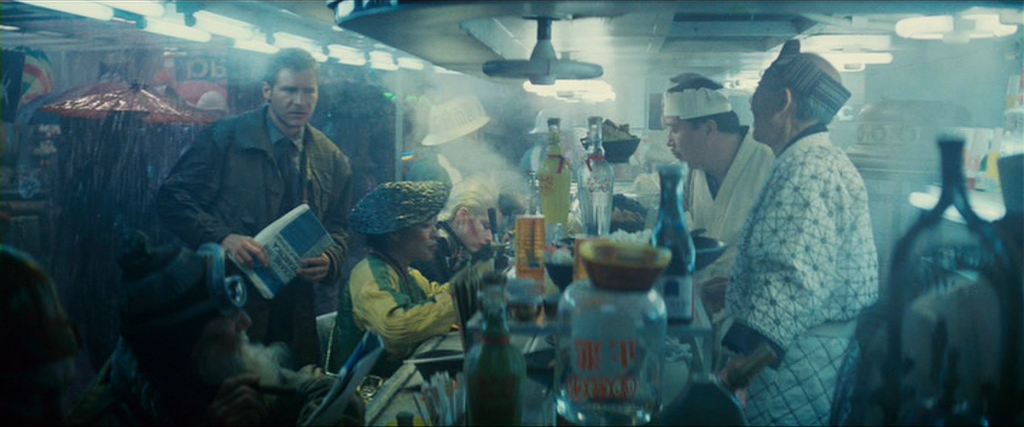
This exaggerated cultural logic of late capitalism finds it's architectural manifestation in a sprawling ground plane which is, in fact, a large market of constant consumption. Here we have the concrete actualisation of Marx's salient criticism of the market behind everything. The image of the silent but every present 'Japanese simulacrum' of a giant advertisement which alternates between seductive Japanese face and a Coca-Cola advertisement is ubiquitous with the film itself.
Consider this against David Harvey's criticism of late capitalism: The multiple degenerate utopias that now surround us the shopping malls and the 'bourgeois' commercialised utopias of the suburbs being paradigmatic – do as much to signal the end of history as the collapse of the Berlin Wall ever did. They instantiate rather than critique the idea that 'there is no alternative', save those given by the conjoining of technological fantasies, commodity culture, and endless capital accumulation.
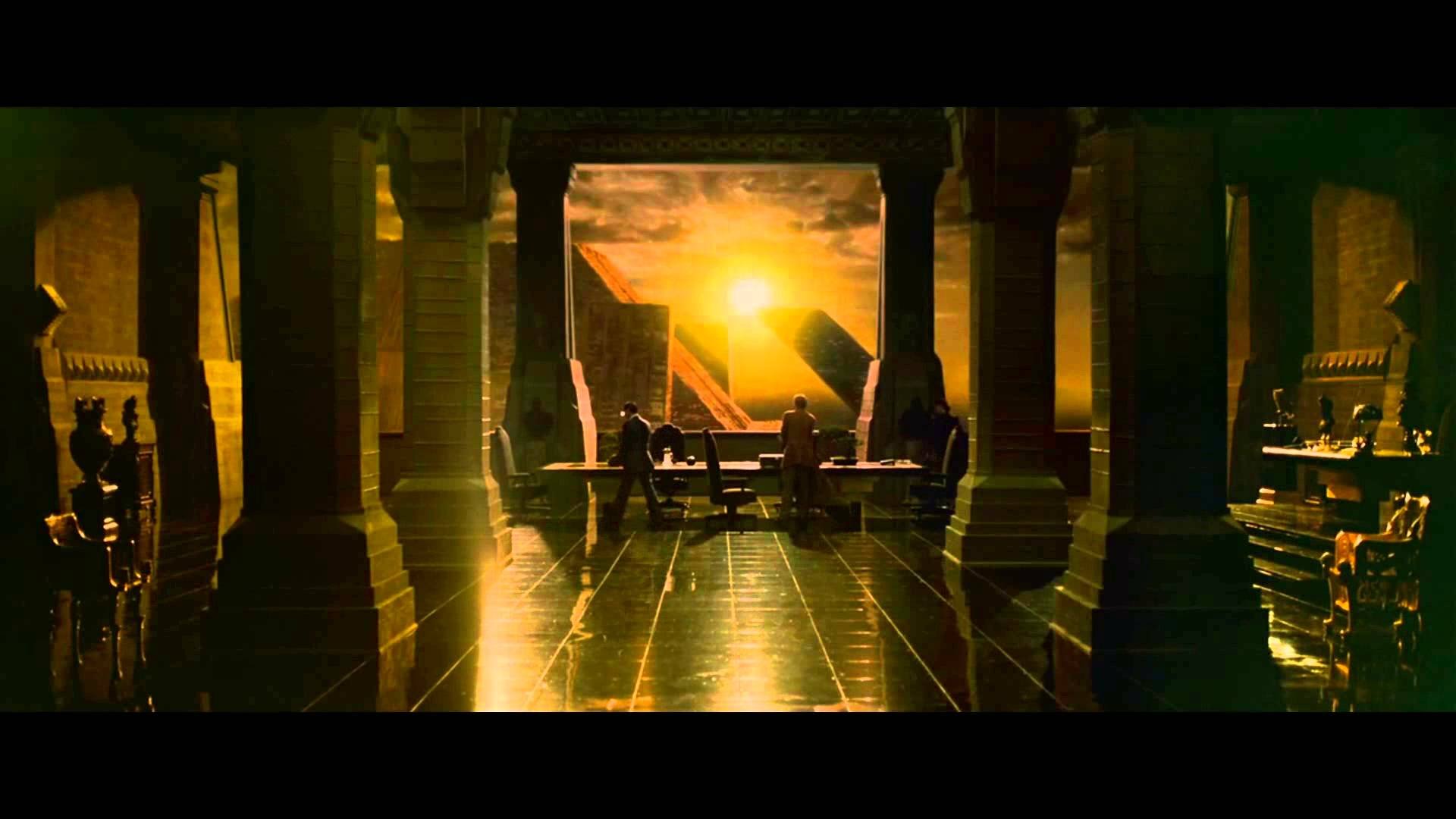
The architecture of the post-industrial city that is 2019 Los Angeles comes to embody the dominant principles of late capitalism; fragmentation of time and space, hierarchization, globalisation, and alienation. The depiction of an urbanity of unimaginable verticality is grounded by a ground plane of densification and crumbling infrastructure. The disturbing cityscape of decrepit ruin that is depicted is only punctuated by the monolithic and sinister Tyrell Corporation ziggurat aesthetically pastiche of pop Egyptian scenography.
In comparison to Metropolis which ties the survival of the city as directly linked to the survival and continued subservience of the underclass, in Blade Runner we are confronted with a future city that is completely fragmented, a city of ruin that plays backdrop to the plot as an extension of the 1980's backdrop of fear surrounding the future of the sprawling city. The depiction ignores certain realities of Los Angeles real urban periphery and instead chooses to present an future urbanity of vertical intensification, degradation and racial conflict which was endemic to then systemic Reaganite fears surrounding multi-culturalism, immigration and ecological collapse during the height of the cold-war.
With exception to the exaggerated verticality, flying vehicles and replicants, a pessimist might see this bleak vision as not that far off given the tenuous state of affairs in the very non-fictional but difficult to believe 2017. We are now in a new form of schizophrenia. No more hysteria, no more projective paranoia, but this state of terror proper to the schizophrenic... The schizophrenic can no longer produce the limits of its own being. He is only a pure screen.
In the plot and setting of Blade Runner, we find the perfect analogue for Baudrillard's theories of simulation and simulacrum, the urban city itself forming the manifestation of the schizophrenic condition. However, this schizophrenic condition of cultural replication and representation seems to fit with Jean Baudrillard's and Francis Fukuyama's evolving ideas of utopia at the time, in fact, they go so far to tell us this: "The United States is utopia achieved."
The obsession of syntaxial and codification of image as part of the central existential plot of Blade Runner reveals as much about the characters as the urban realm that allows for the suspension of belief such a scenario entails. The comparison to contemporary architecture is tacit, Dutch architectural theorist Roemer van Toorn summarises it well: As practicing architect, you no longer know where to look. Every innovative move is doomed to failure from the start. The only thing that proves durable is a specialized, mesmerising style. The architectural profession shuts itself up in an aesthetic vacuum. We live in a schizophrenic situation where the dominant reality is concealed behind an extremely visible and ostensibly liberal pseudo-reality. In short, the critical tradition is going through a crisis.
The Rejection of Utopian Thinking
In the shifting depictions of the future city in utopia/dystopia in science fiction as exemplified by the inherently modernist Metropolis and postmodern Blade Runner we see the recurring themes that utopian longing for a better future become of focus of societal fear and dystopic imaginings. The marked shift between the two films in regards to architecture is found in depictions of the urban realm, the future city of Metropolis in itself is not inherently bad, it is made that way through classist division of labour and the perceived threats of technological change. Within Blade Runner we find the opposite is true, the city is an extension of the effects of late state capitalism, it is post industrialism and the postmodern in decaying concrete form.
Postmodern architecture and urbanism has from its very inception been framed as anti-utopian. This does not mean the indulgence in the multiplicities of utopian schemes is verboten, but rather that the postmodern is cast in direct opposition to the modernist approach and program of sweeping progress. Architectural critic Paul Goldberger states the origins of postmodern architecture emerged 'from the modest, anti-utopian impulse, from a belief in the incremental movement rather than cataclysmic change.'
The difficulty of the Metropolis/Blade Runner analogue is that in reality rather than fiction, the architectural discourse has broadly abandoned utopian thinking in favour of cynical opportunism and irony. Anti-utopian thinking is not new, but it has been emboldened by the rise of the neo-liberal regime and the decline of state socialism as a viable alternative. David Harvey who has written extensively on the topic posits that Utopian longing has given away to unemployment, discrimination, despair and alienation in our built environments and our imaginations as spatial practitioners.
For American architectural theorist M. Christine Boyer the rejection of utopic ways of thinking leaves only piecemeal renewal of the façade of urban space and strengthens the subterfuge of spatial politics at play in the colonisation of the realm of the ubiquitous neoliberal city. For Boyer the role of Debord's spectacle is not forgotten in this obfuscation of the public realm: If the spectator is mired in realistic narrations and offered no utopic visions, what will produce a disposition for social change, an inclination to draw affinities across all the spaces and peoples of the city? What moral authority can be drawn on to challenge the private claims that have distorted the public sphere?
In this way, Boyer criticises 'Disneyfication' of public space long since fetishised by Baudrillard and other semiologists for its utilisation of simulacrum and the embodiment of their ideas of the hyperreal. American Architect and theorist Michael Sorkin substantiates Boyers criticisms of the postmodern urbanity, arguing that in lieu of the once so prominent utopic vision for which architecture was imbued now all that remains that makes it unique, is its remarkable absence. What he calls an urban area 'awash in trumped (often Trumped) up history.'
The most succinct criticism of the postmodern approach to contemporary architecture is being complicit in denying responsibility for the failures of incoherent architectural and urban methodologies. On elucidating the notion of 'Reproducing the dream-image, but reject[ing] the dream', Susan Buck-Morss in her indictment of contemporary postmodern approaches to urbanity and architecture best surmises: In this cynical time of the 'end of history', adults know better than to believe in social utopias of any kind - those of production or consumption. Utopian fantasy is quarantined, contained within the boundaries of theme parks and tourist preserves - like some ecologically threatened but nonetheless dangerous zoo animal. When it is allowed any expression at all - it takes on the look of children's toys, even in the case of sophisticated objects - is if to prove that utopias social space can no longer taken seriously; they are commercial ventures, nothing more.
Conclusion
This essay has sought to link the shifting depictions of modernity and the 'future city' in the seminal science fiction films of Fritz Lang's modernist Metropolis (1927) and Ridley Scott's inherently postmodern Blade Runner (1982) as a way of understanding the postmodern rejection of utopian ideals prevalent in the contemporary architectural discipline. The essay considers that the outright rejection by contemporary architecture to genuinely engage with utopic ideas of the 'future city' and 'utopic urbanity' lead to an architecture that is compromised and complicit with a neoliberal post-industrialised hegemony.
Through the engagement and lens of cultural theory as applied to architecture and its depiction in film and Debord's notion of 'The Spectacle', the essay has sought to reveal prevailing flaws in the fragmented and pastiche language found within the notion of 'incremental change'. Revealing the reliance on irony, insincerity and semiotic coding as a mask that hides larger political and economic disruption of public space. The essay finds the current inability in envisioning a progressive utopic 'future city' either in fictional dreaming or concrete reality by the architectural discourse.
References
Adam, Thomas. Germany and the Americas: Culture, Politics, and History: A Multidisciplinary Encyclopedia. Transatlantic Relations Series. Santa Barbara, Calif.: ABC-CLIO, 2005.
Baudrillard, Jean. The Ecstasy of Communication. Translated by Bernard Schütze and Caroline. Semiotext(E) Foreign Agents Series. Los Angeles: Semiotext(e), 2012.
Benjamin, Walter. The Work of Art in the Age of Mechanical Reproduction. Prism Key Press, 2010 (Original work published 1935).
Boyer, M. Christine. The City of Collective Memory: Its Historical Imagery and Architectural Entertainments. Cambridge, Mass.: MIT Press, 1994.
Bruno, Giuliana. "Ramble City: Postmodernism and Blade Runner." October, no. 41 (1987): 61-74.
Buck-Morss, Susan. Dreamworld and Catastrophe: The Passing of Mass Utopia in East and West. Cambridge, Mass.: MIT Press, 2000.
Calvino, Italo, and William Weaver. Invisible Cities. London: Vintage, 1997 (Original work published 1974).
Chambers, Iain. Migrancy, Culture, Identity. Comedia. London; New York: Routledge, 1994.
Davis, Mike. Ecology of Fear: Los Angeles and the Imagination of Disaster. New York: Vintage Books, 1999.
Debord, Guy, and Donald Nicholson-Smith. The Society of the Spectacle. New York: Zone Books, 1994.
Frampton, Kenneth. Modern Architecture: A Critical History. World of Art. 4th ed. London: Thames & Hudson, 2007.
Gaudette, Emily. "Blade Runner: How Close Are We to Flying Cars and Replicants?" Newsweek. Published electronically October 5, 2017.
Glancey, Jonathan. "From Metropolis to Blade Runner: Architecture That Stole the Show." The Guardian, June 11, 2009.
Goldberger, Paul. "Postmodernism: An Introduction." Architectural Design 47, no. 4 (1977): 256-260.
Harbou, Thea von, Fritz Lang, Alfred Abel, Brigitte Helm, and Gustav Fröhlich. Metropolis. [Electronic Resource]. [Subiaco, W.A.: Kanopy, 2012] Fully restored digitally remastered version.
Harvey, David. "Cities of Dreams." Guardian, October 15, 1993, 18.
Harvey, David. Justice, Nature, and the Geography of Difference. Cambridge, Mass.: Blackwell Publishers, 1996.
Harvey, David. Spaces of Hope. Edinburgh: Edinburgh University Press, 2000.
Jameson, Fredric. Postmodernism, or the Cultural Logic of Late Capitalism. Post-Contemporary Interventions. Durham: Duke University Press, 1991.
Lang, Fritz. "Destruction of 'Heart Machine' Sequence from Fritz Lang's Metropolis," 1927.
Lang, Fritz. "'Metropolis Opening Sequence' Sequence from Fritz Lang's Metropolis." architecture.org, 1927.
Mancini, Marc. "The Future Isn't What It Used to Be." The Future as Depicted in Movies 21 (May/June 1985): 11-15.
McLuhan, Marshall. Understanding Media: The Extensions of Man. London: ARK Paperbacks, 1987.
Parmalee, Patty Lee. "Rethinking Utopia: From Metropolis to Batman." Rethinking Marxism 4, no. 2 (1991/06/01): 79-91.
Pinder, David. "In Defence of Utopian Urbanism: Imagining Cities after the 'End of Utopia'." Geografiska Annaler: Series B, Human Geography 84, no. 3-4 (2002/10/01): 229-241.
A Police Spinner Flying Beside Huge Advertising-Laden Skyscrapers. Blade Runner at 25: Why the Sci-Fi F/X Are Still Unsurpassed. Popularmechanics.com, 2017. Film still.
A critical analysis of cinematic urbanism, originally presented at the University of Melbourne, October 2017.